CRM for Factories, Workshops and Companies in Egypt 2026: The Complete Guide
A CRM for factories and workshops follows each customer from the first contact to the last pound collected, through the site visit, quote, production and installation. What separates it from a generic sales tool is that it understands made-to-order work in Egypt: measurements taken on site, different units for each activity, customers who approve from their phone, and field staff who only need their own tasks.
This guide explains when an Egyptian company needs such a system, what it should cover, and how to choose and start without fuss.
In this guide
- Why organising sales and operations matters for Egyptian factories and workshops in 2026
- What a factory CRM is, and how it differs from accounting software
- The full cycle from lead to collection
- How the system adapts to your activity, out of 24
- How to start, how to choose, and common questions
Why do Egyptian factories and workshops need a CRM in 2026?
Because the market is large and growing, competition on price and speed is intense, and most companies still run customers on Excel sheets and WhatsApp groups. One system shortens the time from enquiry to quote, shows the status of every order, and stops revenue leaking between stages.
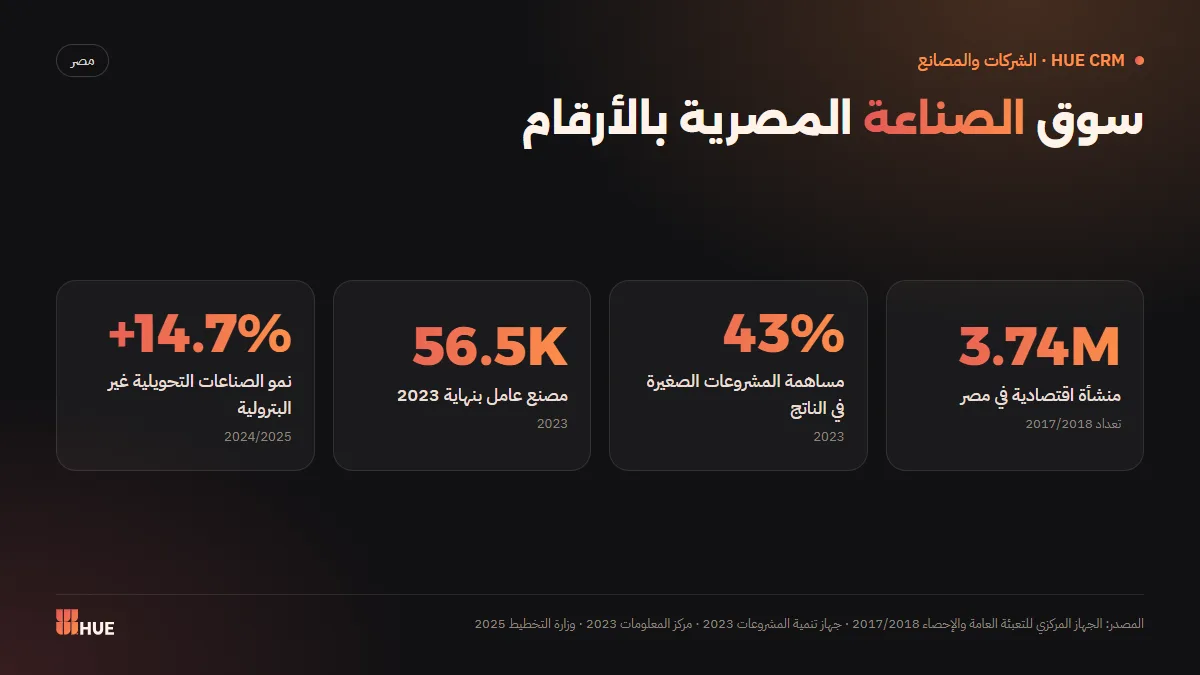
The official numbers show the size of the base. CAPMAS's 2017/2018 Economic Census counted 3,742,562 economic establishments. According to MSMEDA (2023), small enterprises contribute about 43% of GDP and over 75% of employment.
In industry, Egypt had about 56,500 operating factories at the end of 2023 (IDSC), and non-oil manufacturing grew 14.7% in FY2024/2025 (Ministry of Planning and Economic Development). The National Industry Strategy aims to lift industry's share of GDP from about 14% to 20% by 2030.
Growth alone isn't enough. In the World Bank Enterprise Survey for Egypt (2025/2026), about 41% of firms said they compete with unregistered businesses. Customers always compare, and the company that answers fastest with a clear, professional quote wins.
What is a CRM for factories and workshops?
It is a system for customer relationships and operations together. It logs every lead and its source, turns the site visit into a quote, the quote into a production order, follows delivery or installation and after-sales, and ends with payments and balances. It covers what happens before and after the invoice, not the bookkeeping.
That is why it differs from accounting software. Accounting answers "how much did we make?" A CRM answers daily questions: which customers are waiting for a quote, who approved but hasn't gone into production, whose installation is tomorrow, who is late on a payment?
| Item | Accounting / e-invoice software | CRM for factories and workshops |
|---|---|---|
| Core question | How much did we make, what tax do we owe? | Where is every customer and order right now? |
| First step | Invoice and journal entry | The customer's first contact |
| Site visit and measurements | Usually absent | Central to the cycle |
| Quote | A document that becomes an invoice | A document the customer approves online |
| Field team | Doesn't use it | Sees their tasks on mobile |
| E-invoice | Issues it and submits it to the ETA | Doesn't issue it; works alongside your software |
What does the full cycle from lead to collection look like?
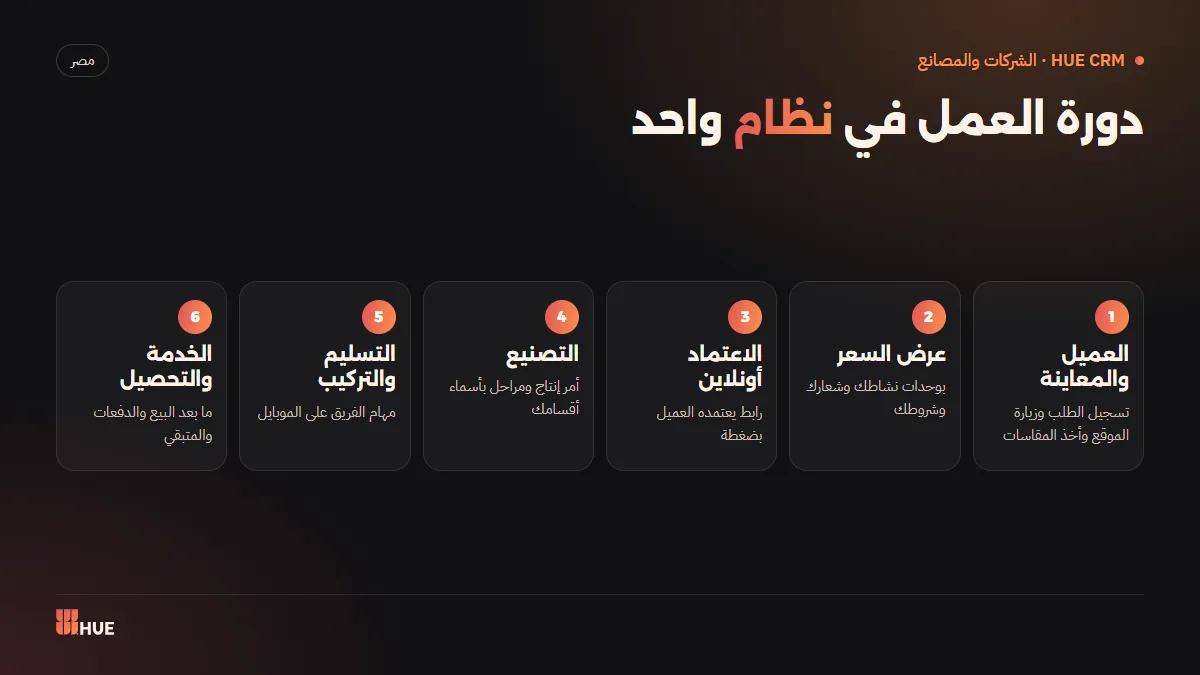
The cycle starts with a customer's enquiry and ends with the last payment, passing through eight clear stops. When each stop is logged in one system, management sees where work stalls and every employee knows what is expected today without endless calls.
- Lead: the request and its source are logged, whether from WhatsApp, ads or referrals.
- Site visit and measurements: the technician visits and records measurements in your activity's units.
- Quote: built with your logo and terms, sent as a PDF and a link.
- Online approval: the customer opens the link and approves in one tap.
- Production order: the job moves to the factory or workshop, under your section names.
- Delivery or installation: installers see only their tasks on mobile; the customer gets a message with the appointment.
- After-sales: service requests and notes after handover are logged.
- Collection: payments and balances per customer, with a confirmation message for each payment.
How does the system adapt to your activity?
The owner picks the company's activity from 24, and units, measurements, section names, order statuses and WhatsApp texts change by themselves. A kitchen factory sees "installation appointment", a building-materials trader sees "delivery appointment", and each has its own units.
The activities fall into five groups:
- Made-to-order manufacturing: kitchens, aluminium and uPVC, glass, doors, marble, metalwork, curtains, signage, printing and packaging, garments, food.
- Finishing and contracting.
- Supply and installation: air conditioning, CCTV, medical devices, solar.
- Trading and distribution: building materials, wholesale, agricultural inputs.
- Services: maintenance, landscaping.
There are 26 units, from piece and linear metre to ton, carton, feddan and kW, tied to the unit codes published by the Egyptian Tax Authority for e-invoicing. If your activity isn't listed, choose "Other activity", type its name, pick the closest of eight ways of working, and adjust units and names as you like.
Which everyday problems does it solve?
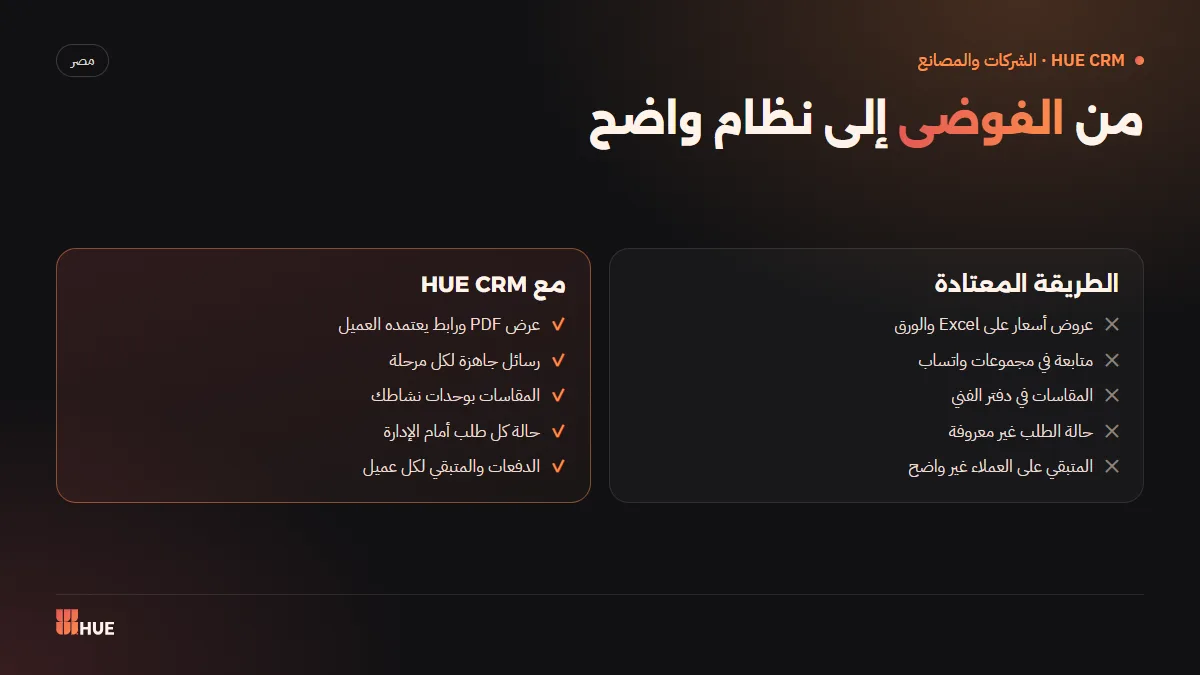
It tackles five problems found in most Egyptian workshops and factories: scattered quotes, follow-up lost in chats, undocumented measurements, order status nobody knows, and outstanding balances nobody chases regularly.
This matters more as costs rise. Urban headline inflation was 14.5% in August 2026 (CAPMAS), and every move in material prices turns an old quote into a liability. We cover this in Quoting in a time of inflation.
Does the system issue e-invoices?
No. HUE CRM runs sales, operations and collections, alongside your accounting or e-invoice software. Its advantage is that its units are tied to the ETA unit codes, so order data reaches your accounting software in the right units.
All Tax Authority taxpayers were obliged to use e-invoicing by 30 April 2023, while e-receipts roll out in phases by decisions that name the obliged taxpayers. We explain who does what in E-invoicing and your sales system.
How does the field team use it?
Every field user — site technician, factory worker or installer — sees only their own tasks on mobile. They don't see other customers' data, need little training, and the order status updates for management with every step they finish.
That suits a market that runs on phones: at the end of 2025 Egypt had 121 million mobile connections (102% of the population) and 98.2 million internet users (DataReportal 2026). Details are in Your field team on mobile.
How does it help with collection?
It records payments and balances per customer, sends a confirmation message for each payment, and reports on sales, collections, lead sources and team performance. Collection moves from the accountant's memory to a clear list you can review weekly.
Cash is life or death here: per the World Bank Enterprise Survey (2025/2026), Egyptian firms fund 88% of their capital spending internally, with banks at just 3%. See Collections and cash flow.
How do you choose the right CRM for your factory or workshop?
Choose the system that matches how you actually work, not the longest feature list. Ask five questions: does it understand my activity and units? Can customers approve quotes online? Can field staff work from mobile? Does it track collection? Does it sit alongside my accounting without conflict?
| Criterion | Why it matters to an Egyptian factory or workshop |
|---|---|
| Adapts to the activity | Units, measurements and names that fit, without coding |
| Quotes approved online | Less waiting for the customer's yes |
| Field user view | Site visits and installation happen outside the office |
| WhatsApp messages per stage | Egyptian customers communicate on WhatsApp |
| Payments and balances | Collection is the basis of cash flow |
| Works alongside accounting | No duplicate invoices, no clash with the ETA system |
| Multiple branches | Each branch with its team, plus combined reports |
How much does HUE CRM for Companies & Factories cost?
Plans start at EGP 790 a month for Launch, then EGP 1,690 for Company and EGP 3,490 for Factory; a yearly subscription gives you two months free. Two optional one-time services: onboarding at EGP 1,000 (free with yearly) and the official WhatsApp Business link-up at EGP 2,000, or both for EGP 2,500.
You can also set up your account yourself at no cost. Plan details are on the pricing section.
How do you get started in two weeks?
Start the 14-day free trial, no card needed, and pick your activity to enter with sample data that fits it. In two weeks you can run the whole cycle on real customers before deciding.
- Pick your activity at sign-up and review units, section names and statuses.
- Add your products and current prices, your logo and quote terms.
- Add office and field users and set each person's permissions.
- Log new customers from day one instead of migrating the whole archive at once.
- Send your first quote with an approval link and follow its status.
- At the end of week two, review sales, collection and lead-source reports.
Conclusion
A CRM for Egyptian factories and workshops isn't another accounting tool; it's the backbone that links sales to operations and collection. In a market of millions of establishments, clear industrial growth and inflation that keeps moving prices, the winners answer faster, deliver accurately and collect on time. HUE CRM for Companies & Factories adapts to your activity and works alongside your accounting.
Sources
- CAPMAS — Economic Census 2017/2018, establishment tables
- Daily News Egypt — Small enterprises contribute 43% of GDP, over 75% of employment (MSMEDA), 2023
- Banker — Operating factories in Egypt at end-2023 (IDSC)
- Ahram Online — Non-oil manufacturing grows 14.7% in FY2024/25 (Ministry of Planning), 2025
- Amwal Al Ghad — Industry to reach 20% of GDP by 2030, 2024
- EnterpriseAM — World Bank Enterprise Survey Egypt 2025/2026 findings, 2026
- Ahram Online — Egypt's annual inflation in August (CAPMAS), 2026
- Amwal Al Ghad — Tax Authority head: e-invoice obligation completed 30 April 2023, 2025
- Egyptian Tax Authority — E-invoicing unit type codes
- DataReportal — Digital 2026: Egypt, 2026
Questions
What's the difference between a CRM and accounting software?
Accounting software records invoices, entries and taxes; a CRM follows the customer from first contact through the site visit, quote, production, installation and collection. The two complement each other.
Does it suit a small workshop?
Yes. The Launch plan at EGP 790 a month is built for small companies getting organised, and you can try it free for 14 days with no card.
Does HUE CRM issue e-invoices?
No. It runs sales, operations and collections alongside your accounting or e-invoice software, and its units are tied to the ETA unit codes.
Does it adapt to my activity, like aluminium or air conditioning?
Yes. Pick your activity from 24 and the units, measurements, section names, statuses and WhatsApp texts change automatically; choose "Other activity" if yours isn't listed.
Does it work on mobile for field staff?
Yes. Site technicians, factory workers and installers see only their own tasks on mobile, without access to other customers' data.
How much does it cost?
Plans are EGP 790, 1,690 and 3,490 a month, and yearly gives two months free. Onboarding (EGP 1,000) and the official WhatsApp link-up (EGP 2,000) are optional one-time services.