Collections and Receivables in Egyptian Companies and Factories 2026: The Numbers
One number sums up cash in Egyptian companies: 88%. That's the share of capital spending firms fund from their own resources, according to the World Bank Enterprise Survey for Egypt, fielded between September 2025 and January 2026. When banks supply only 3% of funding, every pound held up with customers is a pound missing from the company's ability to buy, produce and grow. This article tells the story in numbers, then sets out a practical way to organise collection.
Why is collection a matter of survival for Egyptian companies?
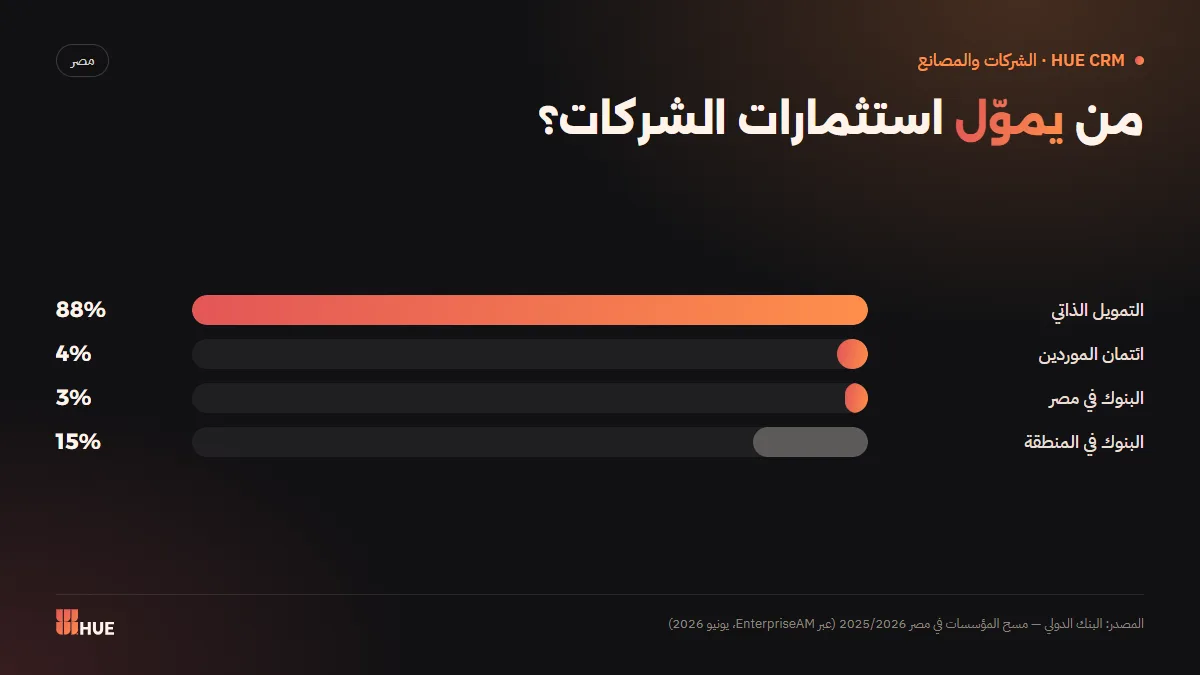
Because firms fund themselves almost entirely. Per the same survey, 88% of capital spending comes from internal funds, 4% from supplier credit, and only 3% from banks, against a regional average of 15%. Internal funds, in practice, mean what you collect from customers.
Made-to-order factories and workshops feel this most: they buy materials and pay wages before delivery, then wait for payments. The longer the gap between spending and collecting, the more cash each order ties up.
What pressures does cash face in 2026?
Three at once: falling real sales, informal competition squeezing prices, and inflation raising material and labour costs. The upshot is that companies need faster collection just to preserve the real value of their money.
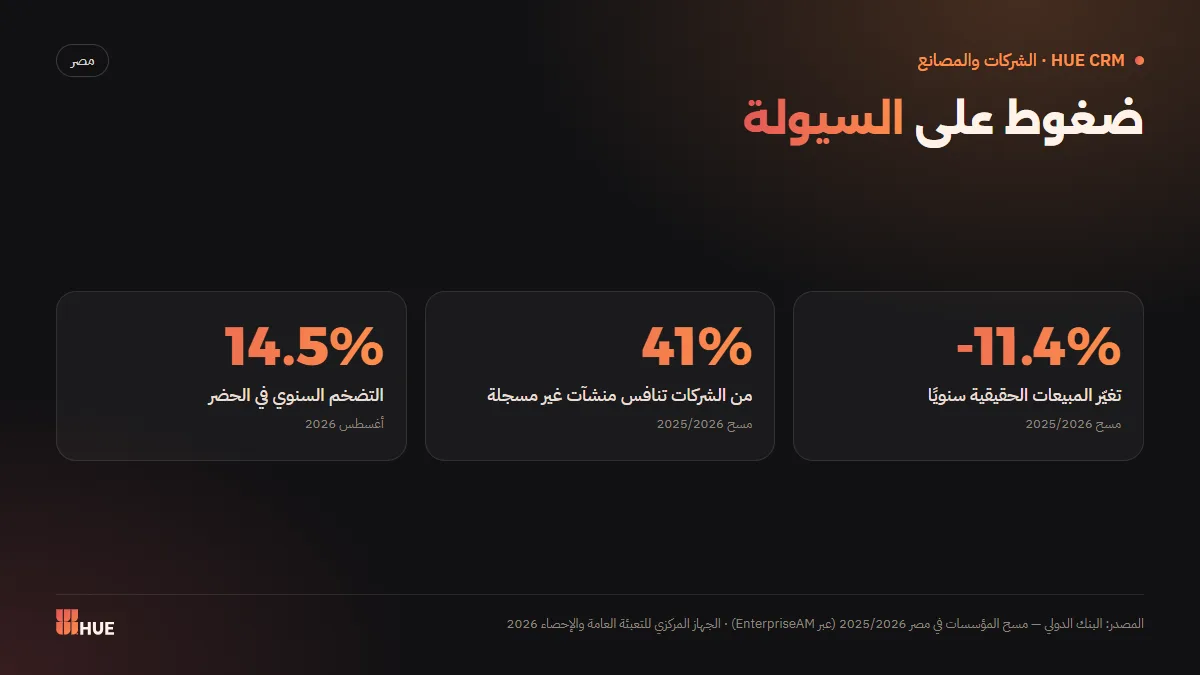
- Falling real sales: firms in Egypt saw real annual sales fall 11.4%, against 5.2% growth across the Middle East and North Africa, per the World Bank survey 2025/2026.
- Informal competition: about 41% of firms said they compete with unregistered businesses, the survey's third-largest obstacle. The OECD puts the informal economy at between 29.3% and 50% of GDP, depending on the data source.
- Inflation: annual urban headline inflation was 14.5% in August 2026 (CAPMAS), so money collected late loses part of its real value every month.
- Contractors' dues: delayed payments to contracting companies have been a recurring issue; in November 2024 the Cabinet's advisory body wrote to the Contractors' Federation about government measures to pay companies' dues.
What's the difference between sales, collection and cash flow?
Sales are what you agreed with the customer, collection is what actually reached your account, and cash flow is the difference between money in and money out over a period. Many companies look profitable on paper while short of cash, because their sales haven't turned into collections yet.
| Concept | Definition | Question it answers | Where it shows |
|---|---|---|---|
| Sales | Value of orders approved by customers | How much did we sell? | Approved quotes |
| Collection | Amounts actually received | How much came in? | Payments recorded per customer |
| Balance (receivable) | Order value minus what's been paid | How much do customers owe us? | Each customer's balance |
| Deferred payment | An amount agreed for a later date | When is it due? | Payment terms on the quote |
| Cash flow | In minus out over a period | Is there enough cash for next month? | Accounting software and collection reports |
How are digital payments changing collection?
They make collection faster and easier to document. Registered customers on Egypt's instant payment network, which InstaPay runs on, reached 22 million by the end of June 2026, according to the Central Bank of Egypt's governor, up from 2.16 million users in the app's first year. The easier it is for customers to pay, the fewer excuses for delay.
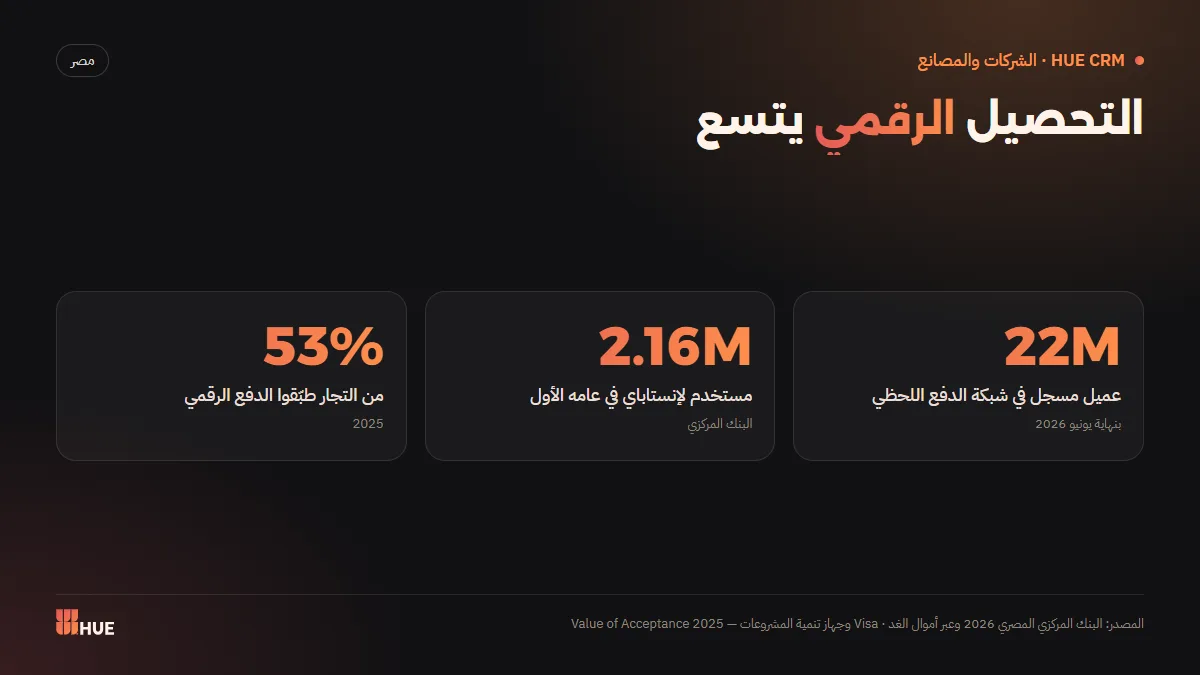
Among businesses, a Visa and MSMEDA study (July 2025) found 53% of surveyed merchants had adopted digital payments in the last two years, and 77% see them as crucial to growth. But digital payment alone isn't enough: every amount must be recorded against the right order, or receivables stay murky.
How do you build an organised collection process, step by step?
Start from the quote, not the invoice: set payment terms before approval, tie each stage of execution to a payment, record every amount as it arrives, and review overdue amounts weekly. Collection becomes part of the order cycle rather than a month-end chore.
- Put payment terms in the quote: down payment, later instalments and dates, as covered in Quoting under inflation.
- Tie production to approval and the down payment: so you don't fund materials yourself for an unconfirmed order.
- Tie payments to execution stages: for example, one on delivery or installation and a final one after handover.
- Record every payment on receipt: so each customer's balance is accurate and the customer gets a confirmation message.
- Review overdue amounts weekly: a list of customers past their due date and who is following up each one.
- Compare sales with collections monthly: a widening gap is an early warning of a cash problem.
Which indicators should you check every week?
Five simple indicators reveal collection health: total outstanding balances, amounts past due, the share of this month's sales collected, delivered orders still missing their final payment, and the ten largest customer balances.
| Indicator | How it's calculated | Why it matters |
|---|---|---|
| Total outstanding | Sum of unpaid customer balances | How much of your money others hold |
| Overdue | Amounts past their due date | First priority for follow-up |
| Monthly collection rate | Collected divided by the month's sales | Are sales turning into cash? |
| Delivered without final payment | Completed orders not fully paid | The most common leak in workshops |
| Concentration | Largest customers' share of balances | Risk of depending on one customer |
These indicators don't need a financial analyst; they just need payments recorded on orders as they arrive. More important than any single week's value is the trend: are balances growing faster than sales? Do the same names keep appearing on the overdue list? Answering those two questions alone reveals most cash problems before they become a crisis.
How do you chase a late customer without losing them?
Good follow-up is regular, polite and documented. A late customer isn't an opponent; the delay is often forgetfulness or waiting on their own cash. It helps to have known, stepped follow-up, and for the customer to know from the quote when each amount is due.
- Before the due date: remind the customer of the next payment and its amount, especially payments tied to delivery.
- On the due date: ask for the payment clearly, stating the stage completed in return.
- A few days late: get in touch calmly, ask for a specific payment date, and note it on the customer's record.
- Repeated delays: revisit terms on this customer's next orders, such as a larger down payment.
- After each payment: the customer gets a confirmation message from the system, keeping the account clear for both sides.
Either way, give each customer one person responsible for follow-up, so they don't get three calls from three employees — or none at all.
Illustrative example: a workshop finds where its money goes
Illustrative example, not real data: a marble workshop sells well but is short of cash every month. Once it began recording payments per customer in the system, a pattern emerged: most overdue amounts came from orders already delivered and installed whose final payment was never requested on handover day. The workshop changed its routine so the final payment is requested as soon as installation is marked complete, and now reviews the overdue list every Sunday.
The lesson isn't a particular number; it's that the problem was invisible until the data lived in one place.
How does HUE CRM help organise collection?
HUE CRM for Companies & Factories records payments and balances per customer, sends a confirmation message for each payment, and links them to the approved quote and the stages of execution and delivery. Its reports cover sales, collections, lead sources and team performance, so management sees where money gets stuck.
It doesn't replace your accounting software or issue e-invoices; it works alongside it, tracking amounts against orders day by day while accounting handles entries and tax invoices, as explained in E-invoicing and your sales system.
Plans start at EGP 790 a month, and yearly gives two months free. Details are on the pricing section.
Conclusion
The numbers tell a clear story: Egyptian firms fund 88% of their investment themselves, banks supply no more than 3%, real sales have fallen, and inflation erodes every late pound. In this environment, organised collection is the cheapest source of cash. Start with clear payment terms on the quote, tie payments to execution stages, record every amount as it arrives, and review overdue amounts weekly. See the full cycle in the CRM guide for factories and workshops.
Sources
- EnterpriseAM — World Bank Enterprise Survey Egypt 2025/2026: firms fund growth from their own pockets, June 2026
- OECD — Informality and Structural Transformation in Egypt, Iraq and Jordan
- Ahram Online — Egypt's annual inflation in August (CAPMAS), 2026
- Amwal Al Ghad — Cabinet advisory body writes to the Contractors' Federation on dues, 2024
- Arab Finance — Instant payment network transactions and registered customers by end of Q2 2026, 2026
- Amwal Al Ghad — InstaPay's first year (Central Bank of Egypt)
- Visa — Egypt SMEs digital payments study with MSMEDA, 2025
Questions
How do I track deferred payments and balances per customer?
Record the approved order's value and each payment on receipt, and each customer's balance appears automatically, with a confirmation message to the customer for every payment.
When should I ask for the final payment?
Tie it to a specific stage written into the quote terms, such as the day delivery or installation is completed, so delivered orders don't turn into overdue balances.
Can I record payments received via InstaPay?
You can record any amount you receive in the system against the right order, and it shows in the customer's balance and collection reports.
Which reports show late payers?
HUE CRM reports sales and collections by period, and with each customer's balance you can review overdue amounts weekly and assign follow-up.
How do I link collection to the quote and the order?
Put payment terms in the quote; after approval, payments are recorded on the same order through production and delivery, so the picture stays connected from quote to final payment.
Does it replace my accounting software?
No. HUE CRM tracks orders, payments and balances day to day, while accounting software handles entries and e-invoices; the two work side by side.