E-Invoicing in Egypt and Your Sales System: Who Does What? A 2026 Guide
Many factory and workshop owners in Egypt ask: "Do I need a sales system that issues e-invoices?" The more accurate answer is that you need two systems that each know their role: accounting or e-invoice software that deals with the Tax Authority, and a sales and operations system that runs everything before and after the invoice. This guide explains the system and its phases, who is obliged to do what, and how the two roles fit without duplication or conflict.
What is Egypt's e-invoicing system?
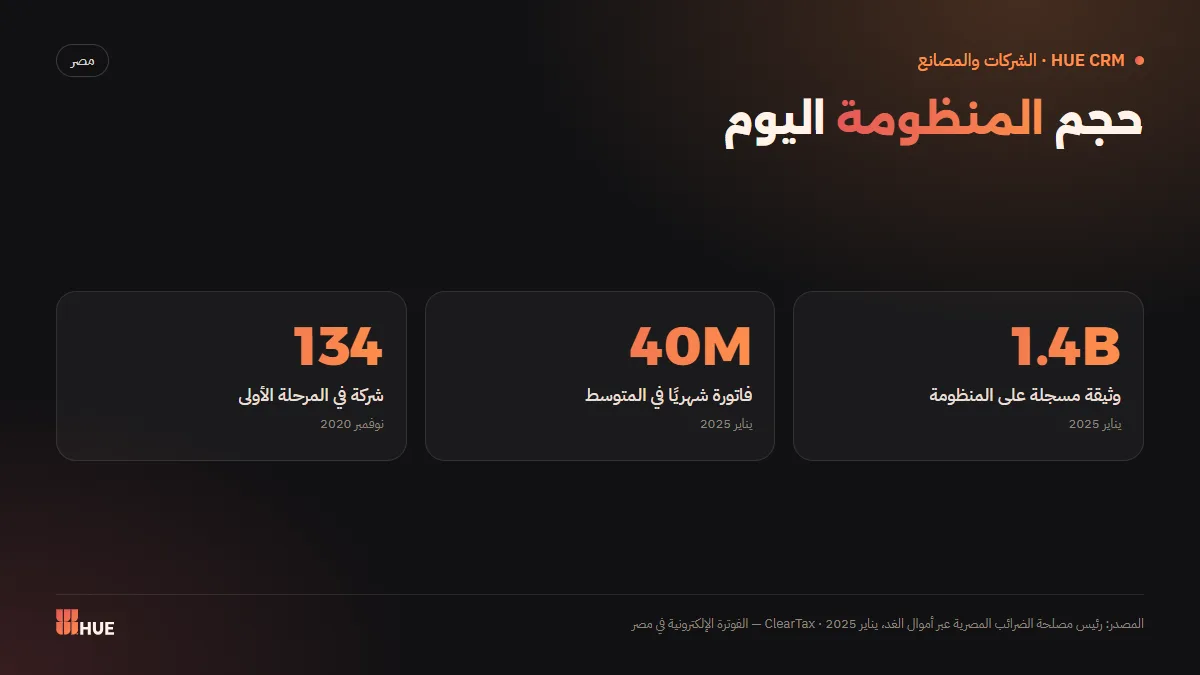
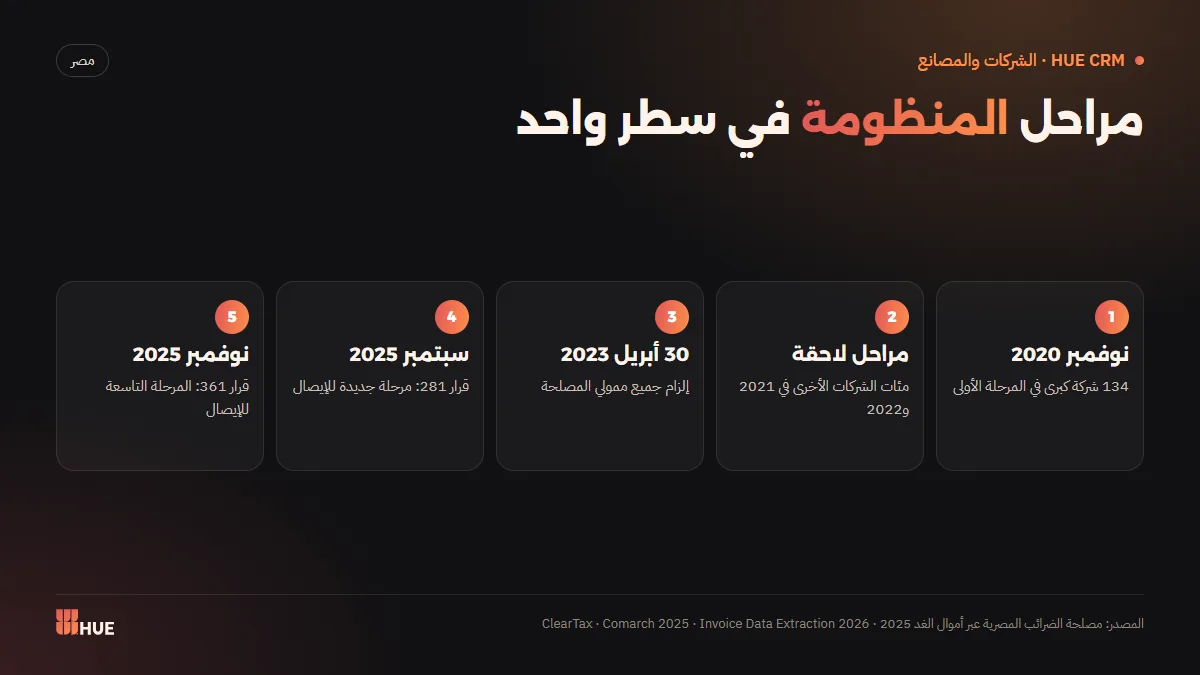
It is the Egyptian Tax Authority's platform to which companies submit business-to-business and business-to-government sales invoices, digitally signed at the moment of issue, so the Authority can validate and record them. It started with large taxpayers in November 2020, and all taxpayers were obliged by 30 April 2023.
It is big. According to the Tax Authority's head in January 2025, the platform held 1.4 billion documents, at about 40 million invoices a month. An invoice usually needs an item code under one of the two accepted coding schemes (EGS or GS1) and an electronic signature before submission.
What's the difference between an e-invoice and an e-receipt?
E-invoices cover sales between businesses (B2B) and to government (B2G); e-receipts cover sales to final consumers (B2C) without a tax number. The first has been mandatory for all taxpayers since April 2023; the second rolls out in phases by decisions naming the obliged taxpayers.
| Item | E-invoice | E-receipt |
|---|---|---|
| Type of sale | Business-to-business and to government | To the final consumer |
| Buyer | An entity with a tax number | Usually an individual without one |
| Who must comply | All taxpayers since 30 April 2023 | Taxpayers named in each phase decision |
| Real-life example | A factory supplying doors to a contractor | A workshop fitting a kitchen in a customer's home |
| Issued from | Accounting or e-invoice software | POS or accounting software linked to the platform |
Who must issue e-receipts?
E-receipt obligations aren't set by a general turnover threshold but by Authority decisions naming the taxpayers in each phase. The right way to check is to look up your company's tax registration number in the obliged-taxpayer inquiry on the Authority's website.
Recent phases include Decision 281 of 2025, requiring named taxpayers to issue e-receipts for all consumer sales from 15 September 2025, and Decision 361, effective 15 November 2025 in the ninth phase. Published compliance guides note that EGP 150,000 isn't a scope threshold but a per-receipt level at which the individual buyer's name and national ID become mandatory.
How have the phases evolved since 2020?
The system grew in steps: 134 large companies in November 2020, hundreds more in 2021 and 2022, and all taxpayers by April 2023. E-receipts for consumers then expanded through successive decisions, most recently in September and November 2025.
Where does a sales system sit relative to the e-invoice?
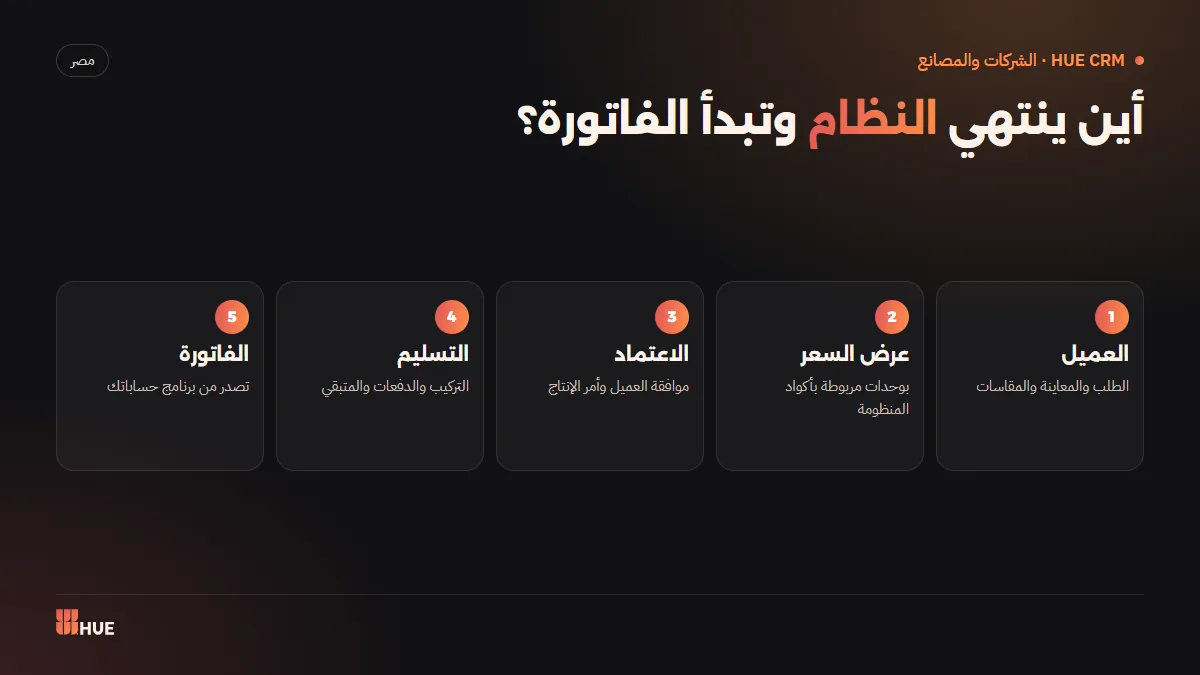
Before and after it. The sales and operations system runs the customer, site visit, quote and approval, production order, delivery and collection; the tax invoice is then issued from accounting software linked to the platform. The first creates the data; the second turns it into a tax document.
That's exactly where HUE CRM for Companies & Factories sits: it doesn't issue e-invoices or submit them to the platform; it works alongside your accounting or e-invoice software. What it adds is that its 26 units are tied to the platform's unit codes, so order data reaches your accountant in the right units.
| Task | Sales & operations system (HUE CRM) | Accounting / e-invoice software |
|---|---|---|
| Logging the customer and source | Yes | Usually not |
| Site visit and measurements | Yes, in your activity's units | No |
| Quote and online approval | Yes | May issue a quote, without online approval |
| Production order and installation | Yes, with tasks for field staff | No |
| Payments and balance per customer | Yes | Yes, in the books |
| Issuing and signing the tax invoice | No | Yes |
| Submitting to the Authority | No | Yes |
Why do unit codes matter in e-invoicing?
Every line on an e-invoice needs a unit code from a list the Authority publishes — BOX for box, CMT for centimetre, and so on. If sales are logged in random units in Excel, the accountant has to convert them by hand, which adds errors and delays.
The problem is sharpest for activities that sell by measurement: marble by the square metre, curtains by the linear metre, building materials by the ton, solar by the kW. When an owner picks their activity in HUE CRM, the matching units appear from 26 units tied to the codes, so the data is right from the site visit itself.
The practical rule is one fixed unit per product or service, used at every stage: the measurement, the quote, the production order and the invoice. If a curtain is sold by the linear metre on the quote, it should appear by the linear metre on the invoice too, not by the piece. That simple consistency saves the accountant hours of checking each month and cuts the number of invoices that need correcting or cancelling after issue.
How do you pass order data to accounting in an orderly way?
Make the approved order the single source of truth: its items, units, prices and payment terms recorded in the system, and the accountant issues the invoice from it in the accounting software. Data isn't typed twice, and what the customer approved matches what is recorded for tax.
- Log the site visit and measurements in your activity's units from the start.
- Build the quote from your product list and send the approval link.
- After approval, follow the order through production and delivery or installation.
- At invoicing time, the accountant issues the invoice in the accounting software from the approved order, its items and units.
- Record payments and balances in the system; the customer gets a confirmation message for each payment.
- Each month, check that delivered orders match issued invoices.
How does your company prepare for e-invoices and e-receipts in practice?
Preparation doesn't start with the invoicing software but with getting the data right beforehand. A company that knows its customers and their details, logs orders in correct units, and knows which sales go to businesses and which to individuals gets through invoicing smoothly. One that assembles data from chats and notebooks at month-end faces constant delays and corrections.
- Classify customers: separate businesses and entities with a tax number from individuals, since the first fall under e-invoices and the second under e-receipts if your company is obliged.
- Capture full customer details from the start: name, contact and, for businesses, tax number, so the accountant doesn't chase them later.
- Standardise units: pick one unit per product or service and use it in the site visit, quote and invoice.
- Review your product list: clear names and current prices, the basis for quotes and then invoices.
- Check your e-receipt status: through the inquiry on the Tax Authority's website, and follow new decisions.
- Assign responsibilities: who logs the order, who confirms delivery, who issues the invoice, and when.
When all of this starts inside the sales system from the customer's first contact, the accountant's job becomes an orderly transfer of complete data, not gathering scattered papers. We show how that data arrives straight from the site in Your field team on mobile.
What are the common misconceptions about e-invoicing?
The most common ones are that one system must do everything, or that e-receipts automatically cover every company. In reality, splitting roles between the sales system and accounting software is clearer and easier to maintain.
- "The sales system must issue the invoice itself": no — what matters is that the invoice comes from software linked to the platform and receives correct data.
- "Every company must issue e-receipts now": e-receipt obligations come through decisions naming taxpayers, so check your status.
- "EGP 150,000 is the compliance threshold": per published compliance guides, it's the buyer-identification level for a single receipt.
- "Quotes must be submitted to the Authority": a quote isn't a tax document; the invoice is what's submitted.
- "Units are a minor detail": every line needs a correct unit code, and mistakes cost time to fix.
Conclusion
E-invoicing in Egypt has been fully in force since April 2023, and e-receipts keep expanding in phases. The cleanest approach for factories and workshops is to split roles: a sales and operations system like HUE CRM runs the customer from first contact to collection and prepares data in coded units, and accounting software issues the invoice and submits it. See the big picture in the CRM guide for factories and workshops, and how to write a tight quote in Quoting under inflation.
Sources
- Amwal Al Ghad — Tax Authority head: 1.4 billion documents; obligation completed 30 April 2023, 2025
- ClearTax — E-invoicing in Egypt: timeline and phases
- Comarch — Egypt expands e-receipt requirements from September 2025, 2025
- Invoice Data Extraction — Egypt e-receipt compliance guide, 2026
- Egyptian Tax Authority — E-invoicing unit type codes
Questions
Is my company required to issue e-receipts?
E-receipt obligations come through decisions naming taxpayers in each phase, so look up your tax registration number in the obliged-taxpayer inquiry on the Tax Authority's website.
What's the difference between an e-invoice and an e-receipt?
E-invoices cover sales between businesses and to government; e-receipts cover sales to final consumers without a tax number.
Does HUE CRM issue or submit e-invoices?
No. It runs sales, operations and collections alongside your accounting or e-invoice software, which issues the invoice.
What are unit codes and why do they matter?
They're a list of codes published by the Tax Authority that every invoice line must carry; HUE CRM's 26 units are tied to them so order data reaches your accountant correctly.
How do I move quote data into my accounting software?
Make the approved order in the system your single data source, and the accountant issues the invoice from it with its items and units, without retyping scattered files.
Is EGP 150,000 the e-receipt compliance threshold?
Per published compliance guides, it's the level on a single receipt at which the individual buyer's name and national ID become mandatory, not a test of which companies must comply.