Digital Transformation for Saudi SMEs: Establishments and Factories in Numbers, 2026
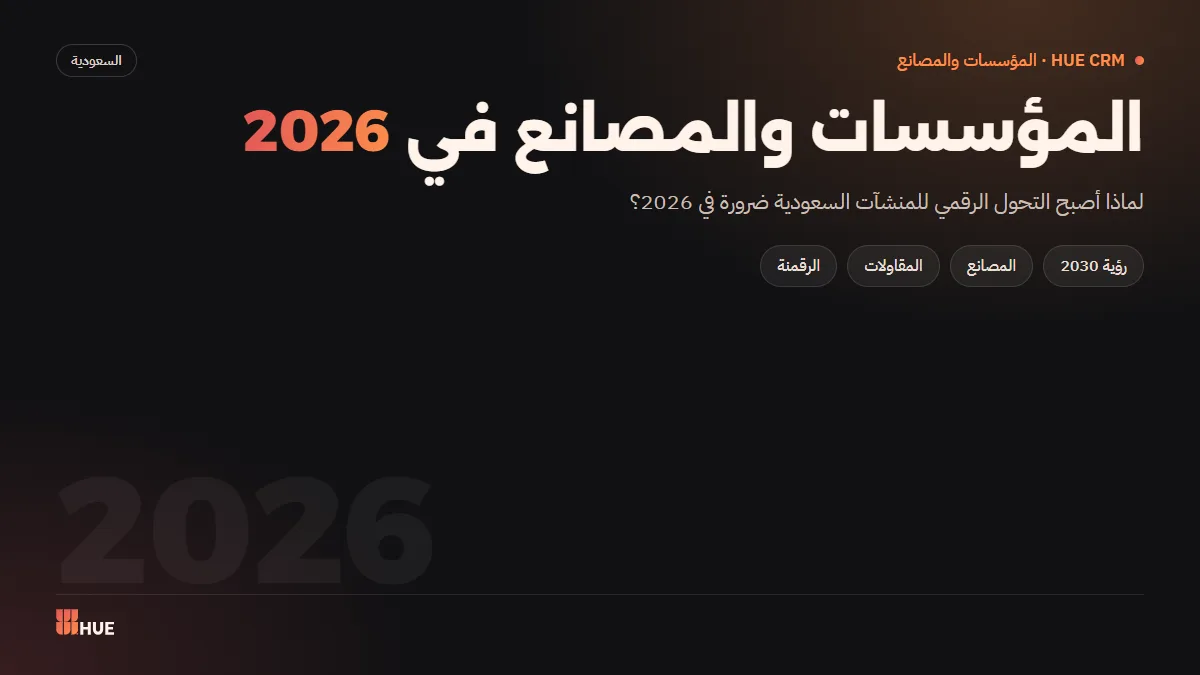
Official figures show the Saudi market has never been more crowded with businesses: about 1.86 million active commercial registrations at the end of 2025, 12,946 existing factories, and more than 365,000 businesses in construction. In a market this size, digital transformation for SMEs is no longer cosmetic; it is a condition for staying competitive.
This article gathers the latest figures published by official bodies, with the source and year of each, for use in your decisions, pitches or research.
In this article:
- The number of establishments and commercial registrations
- Vision 2030 targets for SMEs
- Factories and industrial investment in 2025
- The size of the contracting and construction sector
- Digital adoption and internet use
- Practical first steps for a small business going digital
How many establishments and commercial registrations does Saudi Arabia have?
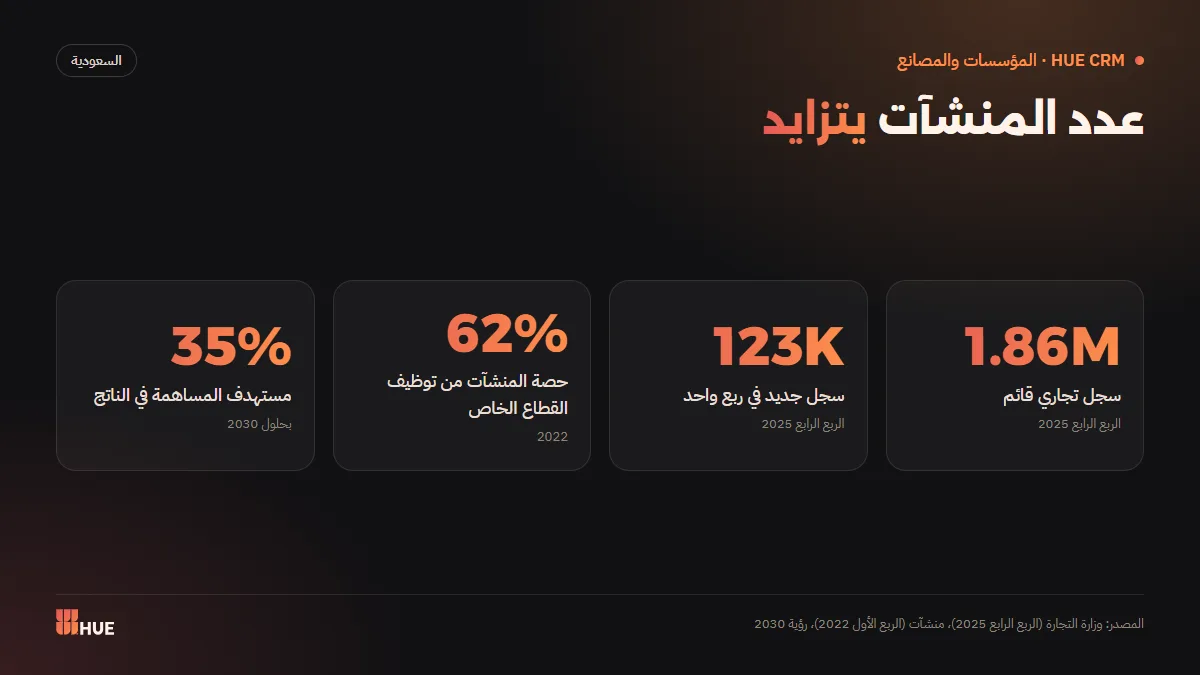
Active commercial registrations reached about 1.86 million at the end of Q4 2025, up 4.2% on the previous quarter, according to the Ministry of Commerce. That quarter alone saw 123,000 new registrations, 48% of them women-owned, and Riyadh, Makkah and the Eastern Province accounted for 69% of registrations issued.
Monsha'at's SME Monitor for Q2 2025 recorded 1.7 million commercial registrations, with more than 80,000 new ones that quarter. The last published count of SMEs on the strict definition was about 1.3 million at the end of 2023. Note that registrations and enterprises are different measures and should not be compared directly.
What is the Vision 2030 target for SMEs?
Vision 2030 aims to raise the SME contribution to GDP to 35% by 2030, from 20% in 2016. SMEs account for about 62% of private-sector employment according to Monsha'at's Q1 2022 report, with an average of 12 employees each.
We found no recent official figure for the current GDP share, so we do not quote one. The target alone shows the direction: the economy is counting on more productive businesses, and productivity in a small business starts with managing time, customers and orders efficiently.
How many factories did Saudi Arabia have in 2025?
There were 12,946 existing factories in December 2025 according to the Ministry of Industry and Mineral Resources, of which 10,394 were operational, employing about 903,547 workers. In 2025, about 1,660 new industrial licences were issued with investment above SAR 76 billion, and 1,201 factories started production with investment above SAR 31 billion.
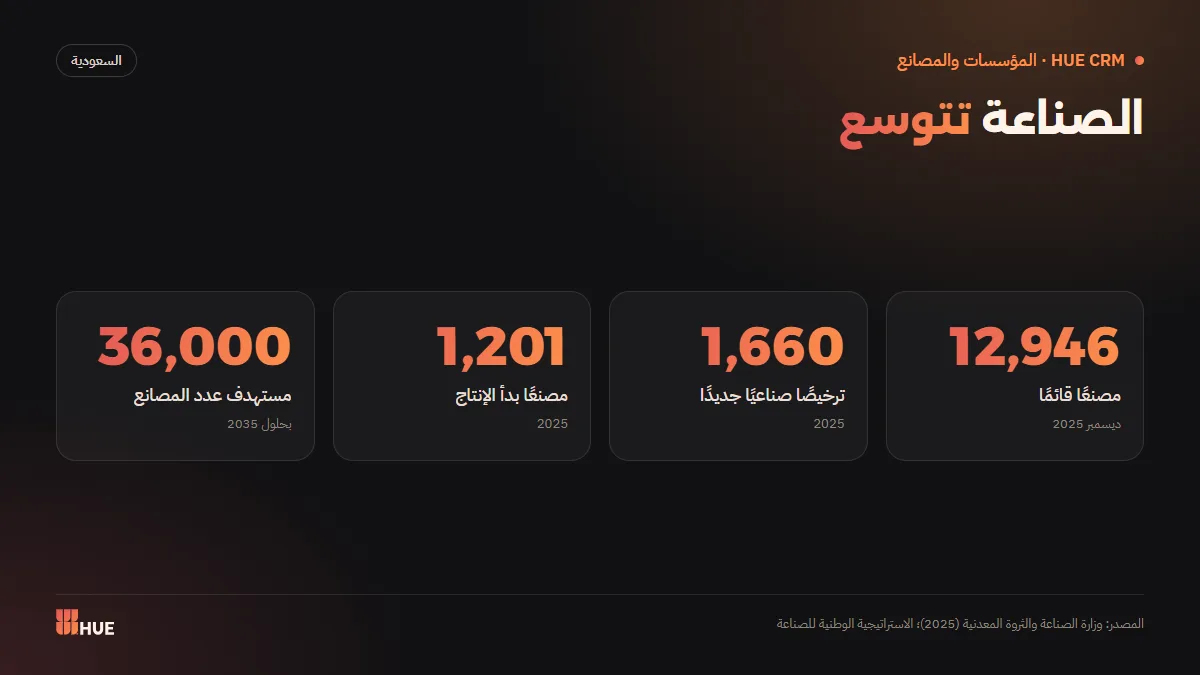
The National Industrial Strategy targets 36,000 factories by 2035, including 4,000 fully automated. At the industrial-cities level, MODON reported 9,557 facilities in its cities in 2025, up 11%, with investments of about SAR 30 billion.
A note on method: some reports cite 9,991 producing factories at the end of 2024. That is a different definition from "existing factories" in 2025, so growth should not be calculated between the two.
How big is Saudi Arabia's contracting and construction sector?
About 117,000 contractors are registered with the Saudi Contractors Authority, according to its chairman in 2026. The construction sector as a whole had 365,120 businesses at the end of 2025, up from about 281,820 in 2024, employing about 4.4 million workers, according to the Authority's annual report as reported by Amlak.
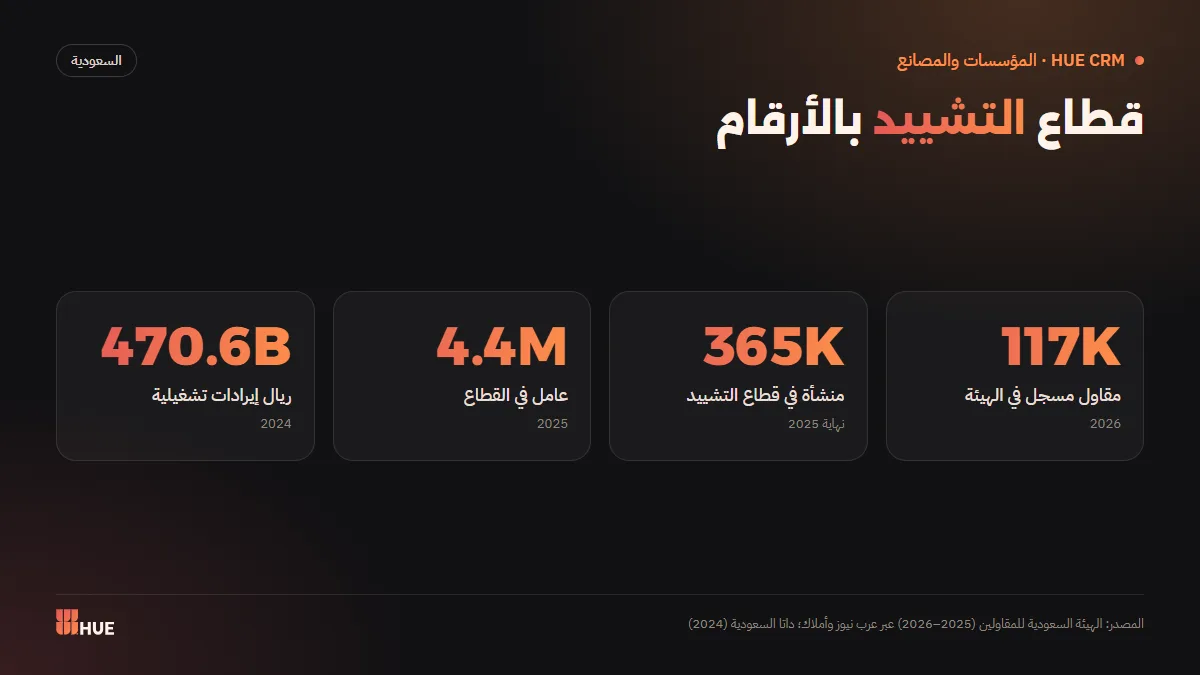
Operating revenues in construction reached SAR 470.6 billion in 2024, up 9.6%, according to DataSaudi, and the sector's real GDP grew 4% year on year in Q4 2025. "Market size" estimates from private research firms vary widely in definition, so we prefer the official figure.
All the figures in one table
| Indicator | Figure | Source | Year |
|---|---|---|---|
| Active commercial registrations | About 1.86 million | Ministry of Commerce | Q4 2025 |
| SME share of private-sector employment | 62% | Monsha'at | 2022 |
| SME GDP contribution target | 35% by 2030 | Vision 2030 / Monsha'at | — |
| Existing factories | 12,946 | Ministry of Industry | Dec 2025 |
| Factory target | 36,000 by 2035 | National Industrial Strategy | — |
| Registered contractors | About 117,000 | Saudi Contractors Authority | 2026 |
| Construction-sector businesses | 365,120 | Saudi Contractors Authority | 2025 |
| Construction operating revenues | SAR 470.6 billion | DataSaudi | 2024 |
| WhatsApp usage among internet users | 92.7% | CST | 2025 |
What do these figures mean for a small business owner?
Big national numbers can feel far from the daily life of a workshop or small establishment, but they translate directly into it. More registrations, factories and contractors mean more competitors for the same customer, and growth in home ownership and construction means more demand for finishing, manufacturing and installation.
- Fiercer competition for every enquiry: a customer you do not answer today has dozens of alternatives
- Growing demand that needs organising: more orders without a system multiply errors and delays instead of profit
- Fully digital customers: they expect a fast WhatsApp reply and a quote that reaches their phone
- Rising regulatory requirements: such as e-invoicing, whose waves now reach smaller businesses
- National productivity targets: a digitally organised business is better placed to benefit from growth
In short, growth is an opportunity for those with the tools to organise it, and a burden for those running on memory and notebooks.
Are Saudi businesses digitally ready?
The infrastructure certainly is. Internet penetration reached 99.6% according to the Saudi Internet Report 2025, there were 34.4 million internet users at the end of 2025 according to DataReportal, 92.7% of internet users use WhatsApp, and 61.3% spend seven hours or more online every day.
But ready people do not mean ready businesses. Academic studies of Saudi SMEs indicate that many still rely on traditional tools, that the main barriers to cloud systems are security concerns and a lack of IT staff, and that manufacturing businesses are less likely to adopt them. That gap between digital customers and manual businesses is exactly what needs closing.
We dedicated an article to the main digital channel where customers start: WhatsApp sales follow-up.
What are the first steps of digital transformation for a small business?
Digital transformation does not mean buying many systems at once. It means moving the processes that cost you money today from paper and memory into one system, step by step, starting with the highest impact.
- Start with customers and orders: log every enquiry and order in one system instead of chats and notebooks.
- Digitise quotes and approval: quotes built on measurements and approved by link, as in The quote approved in one tap.
- Link sales to operations: turn the approved quote into production and installation orders, as in From measurement to installation.
- Connect to accounting: send invoice drafts to the accounting software that issues the e-invoice.
- Measure weekly: enquiries, quote approval rate, late orders and amounts due.
Are cloud systems safe for business data?
Security in cloud systems depends on both the provider and how you use it. Ask any provider about role-based permissions, backups and where data is stored, and internally enforce strong passwords, no shared accounts, and immediate removal of access when an employee leaves.
Compared with files scattered across personal devices and phone chats, a cloud system gives the business more control over who sees what, and keeps customer data inside the business even when staff change.
Summary
The official figures paint a clear picture: more establishments, more factories, more contractors, and customers online all day. The businesses that succeed in this market manage customers and orders digitally, reply faster, deliver on time and collect without delay. Start with one clear step, and to see what the right system looks like, read the complete guide to CRM for establishments and factories.
Sources
- Ministry of Commerce via Mubasher — Existing commercial registrations surpass 1.8 million in Q4 2025, 2026
- Monsha'at via Zawya — SME Monitor Q2 2025: 1.7 million registrations, 2025
- Monsha'at via Arab News — 1.3 million SMEs at end-2023, 2024
- Monsha'at via Arab News — SMEs at 62% of private-sector employment, 2022
- Arab News — 35% SME GDP contribution target, 2024
- Alraedah Finance — Annual Report 2023 (20% baseline in 2016), 2023
- Ministry of Industry and Mineral Resources via Arab News — 2025 industrial indicators, 2026
- Asharq Al-Awsat — Saudi Arabia targets 36,000 factories by 2035
- MODON via Riyadh Daily — 2025 results, 2026
- Arab News — About 117,000 contractors registered with the SCA, 2026
- Amlak — 365,000 businesses and 4.4 million workers in construction, 2025, 2026
- DataSaudi — Construction sector, 2025
- Arab News — Saudi Internet Report 2025, 2026
- DataReportal — Digital 2026: Saudi Arabia, 2026
- Saudi Digital Library — Barriers to cloud adoption among Saudi SMEs, 2024
Questions
How many factories are there in Saudi Arabia?
There were 12,946 existing factories in December 2025 according to the Ministry of Industry and Mineral Resources, of which 10,394 were operational, employing about 903,000 workers.
How many commercial registrations does Saudi Arabia have?
About 1.86 million active commercial registrations at the end of Q4 2025 according to the Ministry of Commerce, with 123,000 new registrations issued that quarter.
What is the Vision 2030 target for SMEs?
To raise their contribution to GDP to 35% by 2030, from 20% in 2016.
What is the National Industrial Strategy?
A strategy that aims to raise the number of factories in the Kingdom to 36,000 by 2035, including 4,000 fully automated factories.
What is the first step of digital transformation for a small business?
Start by logging all customers and orders in one system instead of chats and notebooks, then digitise quotes and approval, and gradually connect sales to operations and accounting.
Are cloud systems safe for business data?
Security depends on the provider and on how you use it. Ask about permissions, backups and storage location, and enforce strong passwords and immediate removal of access when staff leave.